Wednesday, 19 March 2014

The Wrestler (2008) - A Movie Review by Andrew Lawrence

Director: Darren Aronofsky
Screenwriter: Robert D. Siegel
Stars: Mickey Rourke, Marisa Tomei and Evan Rachel Wood
Trailer link
IMDb page

Two different movies with the same general theme:
As I am writing this review, Darren Aronofsky's new film Noah is just about to hit theaters all over the globe. It stars Russel Crowe in the titular role as the famous biblical character, and being a huge fan of both Crowe and Aronofsky, Noah is one of my most anticipated films of 2014. My personal favourite Aronofsky film is Black Swan from 2010, a movie which focuses on the physical and emotional punishment that is associated with being a ballet dancer. In The Wrestler from 2008, Mickey Rourke does not exactly dance ballet, but his character is extremely similar to Natalie Portman's character from Swan, in the fact that his profession has become much more than just a regular job. Black Swan is about an entertainer who is just about to make into the big leagues, and The Wrestler is about an entertainer on the decline, who has already had his moment, and who has to deal with the consequences of having worked in the entertainment business for way too long. 

Burning the candle from both ends:
The Wrestler opens with a long panning shot of different newspaper cut-outs from the 1980's. This opening tells the tale of Randy "The Ram" Robinson's time as the most famous and successful professional wrestler in America, and after a brief cut to black, we see The Ram of today, sitting in a children's class room in some local high school. He is battered and bruised from his latest match against a young local hotshot, who just might be the next big thing in the world of wrestling. Since the 80's, The Ram has become a broken down, physically deteriorated wreck of a man, who sleeps in the back of his equally dented van, whenever he does not have enough cash to stay in the dirty, miserable trailer that he calls his home. The Ram has no friends worth speaking of, no wife, no girlfriend, and no family besides a grown up daughter who hates him, because he was not there for her during her early years. The Ram, Randy Robinson, Robin Ramzinsky or whatever you want to call him, basically lives a lonely and depressing life, and when a heart attack threatens to take away the one thing he has ever been good at, our hero's past finally seems to have gotten the best of him. 

An actor is reborn in Aronofsky's darkness:
Aronofsky has a tendency to make extremely bleak movies, and The Wrestler is not any different. This movie is probably the director's most somber movie since the black hole of hopelessness that is Requiem for a Dream, which is the most beautiful movie that I never want to watch again, but whereas that movie consists of 100 % depression, The Wrestler has an enormous amount of heart and emotional staying power as well. Mickey Rourke's real life career has been very similar to The Ram's, and he channels so much of that personal experience and heartbreak into this role, that you eventually start to care just as much about him as an actor as you do about the character that he is portraying. Rourke was born to play this role, and he does it phenomenally well, delivering a subdued yet tremendously powerful performance, that will go down in history as one of the best and most personal physical performances of all time. I have seen Milk, and although Sean Penn was great in it, Micky Rourke should have won the Oscar for his heartbreaking portrayal of Randy "The Ram" Robinson in The Wrestler.  

Career-based drama:
In the middle of all his misery, The Ram actually has one person whom he can go to in search for comfort. Her name is Cassidy, she is a stripper, and she is the type of character who normally stays flat and uninteresting throughout a film, and whose only purpose is to act as a brick wall which the main character can express his feelings to. However, in case of The Wrestler, this supporting character is everything but a cheap plot device. Thanks to Robert D. Siegel's incredible script and Marisa Tomei's wonderful performance, Cassidy becomes a mirror in which The Ram sees himself and finds some peace of mind, albeit a fragile and somewhat fake peace. The gap that exists between a professional wrestler and his audience is just as big as the one that exists between a stripper and her customers, and even though Rourke is fully aware of this thanks to his long career in entertainment, he can not help himself from falling for Cassidy. Her character is very similar to Randy "The Ram" Robinson and Nina from Black Swan in terms of profession, identity, facades and sadness, and she could easily have carried a standalone film on her shoulders.

Praise where praise is deserved:
Darren Aronofsky has been one of my favourite film directors for a long time now, and even though I have yet to watch Pi, I do not believe he has made anything but incredible films as of yet. With The Wrestler, Aronofsky and Mickey Rourke have created a sports movie unlike any other, and in spite of its very limited budget, it manages to enchant and haunt me every time I watch it. 

Saturday, 15 March 2014

Lawrence Uncut: My Top 10 Favourite Movies of 2013

Better late than never:
So yea, I know that 2013 is long gone by now, but I still really want to make one of these lists. I did not get to review every good movie I saw last year, and even though I will not get the chance to go into very great detail about them, I still feel as if writing a top 10 list will give me the opportunity to express my thoughts on a lot of really good films, that definitely deserve to be talked about. As with everything else I write here on my blog, this top 10 will be extremely subjective and personal, and it will probably piss a lot of people off as a result thereof. It is also important to keep in mind that I did not get to watch every single movie from 2013, so if you wonder who titles such as Frances Ha, Frozen, Lone Survivor, Osage: Orange County, Philomena, The Wind Rises and The Hobbit: The Desolation of Smaug are not anywhere to be found on the list, it is simply because I have not seen them yet. However, as an added bonus to those who read the entire list, I have included a list of honorable mentions at the bottom of this post, which contains the movies that I wish could make it to the list, but just did not make the final cut. With all that boring stuff out of the way, I think it is about time we get into my top 10 favorite movies of 2013.

#10 - The spectacular now
To start off the list, we have James Pensoldt's adaption of the writers of 500 Days of Summer's third screenplay. Not only is this film one of the best teen romances of 2013 in my opinion, but also one of the most realistic and relatable romantic movies that I have seen for a long time. I vividly remember watching this film a cold Wednesday afternoon whilst feeling a little sick, and being in the fragile state that I was, this film's honest and emotionally draining story swept me off my feet even more than 500 Days of Summer did. Miles Teller and Shailene Woodley play the two main characters in this indie coming of age high school love story, and both of them deliver the performances of their careers in my opinion, especially Woodley, who I am sure has a long and bright acting career ahead of her. Being at a very similar point in my own life as the two main characters are in this film, I felt a strong connection to both of their characters, and after the film had ended, I just sat still and stared at the screen with wet eyes for more than ten minutes. The Spectacular Now is one of the best romances of 2013 for sure.

#9 - Nebraska
Nebraska is director Alexander Payne's latest movie, and even though I personally think that The Descendants is his best movie yet, Nebraska is one of the funniest, most engaging and most well created movies I saw in 2013. In this film, Bruce Dern plays a drunken old man by the name of Woody, who struggles with a lot of regret over what he has and has not achieved throughout his life. As he embarks on a road trip to his home town along with his youngest son, played brilliantly by Will Forte, Woody gets a chance to fix some of the broken relationships and settle some of the disputes that have been troubling him for many years. Shot beautifully in black and white, Nebraska is one of the most personal movies I saw in 2013, and I almost felt as if I could reach out and tough its many-layered characters whilst watching the film. Dern is brilliant in this film, and so is his wife played by June Squibb, who delivers one of the funniest performances of the year. Please, do not let the black and white fool you, because Nebraska is one of the most strangely heartwarming and colorful movies of 2013. 

#8 - Fruitvale Station
This one is a true gutwrencher. As I said in my review of the film, Fruitvale Station is based on the real life shooting of 22-year-old Oscar Grant on the last day of 2008, and it is one of the most harrowing films of 2013 for sure. The amount of emotional attachment I felt towards this individual, no matter how many wrong choices he might have made throughout his life, was stronger than almost any other connection I felt towards a film character from last year. This is largely due to newcomer  Michael Jordan's phenomenal performance and first time director Ryan Coogler's extraordinary directional effort, and I absolutely cannot wait to see what the two of them come up with next. The most impressive thing about this film, is the fact that Coogler managed to make a very open minded and neutral film based off of a story that very well could have turned into an extremely one-sided affair, which is a feat that a lot of more established Hollywood directors do not always manage to pull off. You can read my review of Fruitvale Station here.

#7 - Inside Llewyn Davis
In my opinion, Ethan and Joel Coen are the two of the best living screenwriters, if not the very best, as well as two of the most reliable directors who still make movies. These two incredible filmmakers just keep on surprising me with their darkly funny, strangely poetic and flawlessly crafted films over and over again, and the way I see it, Inside Llewyn Davis is their best movies since No Country for Old Men. It might not be all the way up there with No Country, Fargo and The Big Lebowsky, but it is still one of the most catchy and melancholically entertaining films of 2013. I usually never listen to music on my own and do not fancy myself a music enthusiast, so the fact that I have listened to all the songs from this movie almost every day for more than a month, should tell you something about how much I loved watching it. The Death of Queen Jane and Please Mr. Kennedy, although very different in tempo and subject matter, are two of the best movie soundtracks I have heard since Ben Nichols' Shelter from the movie Take Shelter, and are just two of many reasons as to why I cannot wait to revisit Inside Llewyn Davis on BluRay. 

#6 - The Way Way Back
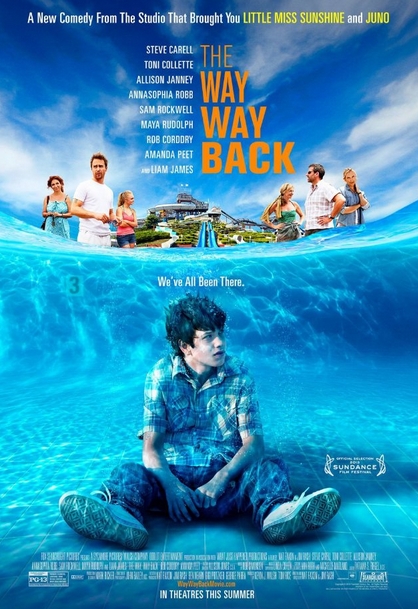
The Way Way Back is one of those movies that you can watch over and over again and never get bored of. Not only is it the funniest movie from 2013 in my opinion, but it is also one of the most heartwarming, loving and honest films I have seen in quite some time. It focuses on a young awkward teenager by the name of Duncan, who is having the worst summer of his life in his douchy stepdad's beach house. Duncan eventually meets Sam Rockwell's character and starts hanging out with him in a water park nearby, which is where he starts learning what growing up, being yourself and falling in love really means. The Way Way Back truly is one of the sweetest, funniest and most loving films I have seen for as long as I can remember, and it captures the essence of teenage mystery, awkwardness and excitement better than most movies in its genre. In my opinion, Sam Rockwell also delivers one the best performances of the year in this film, and even just thinking about his monologue about the reason as to why the water park was founded still cracks me up even today. In short; please, for the sake of your inner child, watch this movie.

 #5 - Mud
As far as I am aware, 36-year-old writer/director Jeff Nichols is going to be remembered as one of the very finest filmmakers from our generation. Shotgun Stories is great, Take Shelter is a timeless masterpiece, and Mud is almost just as good. This film is a coming of age story just like The Spectacular Now and The Way Way Back, but more so than those two other films, Mud is an incredibly profound, many layered tale about love, friendship, mystery and the path to becoming a grown up human being. It features the two best performances by young actors from 2013 in Tye Sheridan and Jacob Lofland, as well as the crown jewel in Matthew McConaughey's career comeback as the titular character "Mud", and the three of them make this film one of the most engrossing movie going experiences of last year. I absolutely cannot believe that Nichols was not nominated for best original screenplay at the latest Oscar ceremony, because the way I see it, Mud's phenomenally well told story, engrossing themes and fateful atmosphere makes it the most well written movie of 2013, even better than Spike Jonze's Her. You can find my full review of Mud here, but please keep in mind that my opinion on the film has changed a lot since I wrote the review. 

#4 - All Is Lost
This film truly amazed me. Although All Is Lost only features one character, has next to no dialogue and takes place almost entirely on a small boat, it is one of the most exiting and nerve wracking films from 2013, as well as the single scariest movie I saw last year. Although Gravity probably will go on to become the most well remembered survival movie from 2013, All Is Lost had me much more engaged and much more worried about its main character. Robert Redford is flat out phenomenal in this film, and if I had to choose a favourite male performance from 2013, I would have to go with his heartbreaking and surprisingly physical portrayal of the unnamed main character in All Is Lost. The fact that writer/director J.C. Chandor and Redford managed to create such a thrilling and crushing movie with as small an amount of scenery and diversion as they did is a remarkable feat, and I still get goose bumps from thinking about the way in which the film concludes. In my opinion, All Is Lost is high concept filmmaking at its very best. 

 #3 - Only God Forgives
Kicking off the top 3, we have the most "controversial" pick on the list. Only God Forgives was absolutely crushed by critiques and audiences all over the world upon its release, but in my opinion, it is one of the most atmospherically pleasing and visually stunning movies that I have ever seen. Yes, it does feature a lot of very slow paced walking and a huge amount of melancholic staring, but no film from 2013 managed to keep me enthralled, riveted and mystified as much as Nicolas Winding Refn's Only God Forgives did. Refn has a very distinctive visual style which borrows a lot of elements from directors such as Stanley Kubrick and David Lynch, and as a direct result thereof, this film feels more like a fever dream than an actual movie. Refn does not waste a single frame in this film, and as much as I hate to be the asshole who says "pfft, you just don't get it!", the people who claim that Only God Forgives does not make sense and has no character progressing or story arc, just did not fucking get it. I personally bought it on BluRay as soon as I got the opportunity, and luckily enough, Only God Forgives only gets better and better the more I watch it. You can read my review of the film here.

#2 - The Great Beauty
The Great Beauty is an Italian film, and it is nothing short of spellbinding. It won the award for best picture in a foreign languae at the Oscars, but in my opinion, only one film from 2013 spoke the language of film better than this aesthetic masterpiece. The movie takes place in Italy, where 65-year-old playboy Jep Gambardella has been navigating the superficial and materialistic highlife of Rome for almost 40 years, without ever having felt happy or fulfilled. He seems to be the only person in his circle of "friends" who actually know that everything they say and do is complete and utter bullshit, and the film goes on to depict how wealth, art and social status has become a hollow shell of nothingness and stupidity for Jep and the people around him. Director Paolo Sorrentino tells this satiric story with some of the most gorgeous and visually pleasing images I have ever seen on film, and the movie contains several of the deepest and most telling sequences I have ever seen in any sort of visual artform. I am ashamed to admit that I have never seen seen a film made by Federico Fellini, but the fact that Sorrentino and The Great Beauty is being compared to Fellini and his work, makes want to change that as soon as humanly possible. You can read my in-depth review of The Great Beauty here.

#1 - Blue is the Warmest Color
When I said that The Great Beauty was my favourite film of 2013 back when I originally reviewed it, it was because I had not seen Blue is the Warmest Color yet. I decided to give it a go out of pure coincidence, and never in my life had I thought that a three-hour-long French movie about a lesbian couple would end up becoming the best film about love and sexuality that I have ever seen. As the poster truthfully states, this movie is absolutely shattering in more ways than I can describe. Not only it a gripping coming of age story about a young girl's personal struggle with friends, school, parents and herself, but it is also a genuinely heartbreaking, honest and realistic depiction of self discovery, homosexuality and love. Adèle Exarchopoulos plays the main character in the film, and she gives the best performance of any actor or actress in any film from 2013, making her character the single most emotionally engaging film persona of the year. I knew within very few minutes that this film was something special, and by the time it ended, I cared more about Adèle than any other fictional character I have encountered all year. Blue is the Warmest Color broke the barrier between fact and fiction more effectively than any other film I have seen for a very long time, and that is why it is the best film I saw in 2013.

Honorable mentions:
The Act of Killing
Out of the Furnace
Rush
Star Trek into Darkness
Filth
Dallas Buyers Club
Short Term 12
Blue Jasmine
Behind the Candelabra
The Kings of Summer
12 Years a Slave
Prisoners
Her
American Hustle
Place Beyond the Pines
Upstream Color
Gravity
Ain't Them Bodies Saints

Wednesday, 12 March 2014

The Constant Gardener (2005) - A Movie Review by Andrew Lawrence


Director: Fernando Meirelles
Screenwriter: Jeffrey Caine
Stars: Ralph Fiennes, Rachel Weisz, Danny Huston, Bill Nighy

One author, two different stories:
The Constant Gardener is a movie from 2005 based on a novel by author John le Carré, the man who also wrote the source material for Tinker Tailor Soldier Spy, a movie which I recently reviewed here on my blog. Whereas I did not have many bad things to say about the adaption of Carré's spy novel, The Constant Gardener is a totally different beast, and the subject matter of the two films could not have been more different. In this film, Ralph Fiennes plays an English UN diplomat who lives in Kenya. Fiennes used to be a modest, calm and hard working man, but when his wife, a hotheaded political activist played by Rachel Weisz comes close to uncovering a gruesome conspiracy and ends up getting herself murdered in the process, Fiennes embarks on a quest to find out what actually happened to his wife, and find out why someone had her killed. 

Politically correct subject matter = great movie?:
Even though The Constant Gardener scored very high ratings on sites such as rottentomatoes.com and metacritic.com, I personally had a very hard time describing my feelings about the film immediately after watching it. It seemed to be one of those movies that was destined to garner a lot of attention at the award ceremonies strictly because of its politically and morally challenging subject matter, in this case big medical companies who test their unsafe drugs on sic and poor Africans, but not because of the craftsmanship, storytelling and actual cinematic weight of the film. Disagreeing with the fact that corporate murder and abuse of the poor living standards in Africa is a horrible crime is very hard to do, and as such, I have a sneaky suspicion that this film got a lot more praise than it actually deserved. In general, it is important to remember that just because the subject matter is important and urgently needs to be discussed, the film is not necessarily either important or well made. 

A struggle to choose between two identities:
One of the things that that I disliked the most about this movie, is the way in which it was shot. The entire film seems to be filmed with handheld cameras in an attempt to make it feel more like a documentary than a factional movie, but in my opinion, this element largely just served to make the film very annoying to look at. Sure, it might add a bit a realism to the over all product, but constantly having the picture shake like a chiwawa with Parkinson's decease gets very frustrating to look at extremely quickly. More importantly however, this documentary-esque feeling made the film seem very conflicted with itself, for more than one reason. If you are so obsessed with pointing out the realistic aspects of your film that you make half of it feel like a documentary and all of it look like a documentary, then why the hell not just make a documentary? You simply can not mix a slightly unbelievable and melodramatic love story about a guy who tries to uncover the nature of his wife's death with serious and hyper realistic depictions of the real world, without making your film seem totally self-conflicted and fragmented. 

Realism or caricature?:
The Constant Gardener's main political agenda is to depict how big medical companies test their unfinished products on sic Africans, and shrug off the moral responsibility by telling themselves that "they were going to die anyway". Although this subject is both horrifying and interesting, the film depicts these companies and their representatives in such a cartoony and caricatured way, that I ended up laughing instead of trembling in moral outrage. Bill Nighy plays the most one-dimensional and stereotypical corporate big-boss that has ever been put on screen in this film, and this character's ridiculous behavior and over the top attitude completely obliterated the small amount of realism that the film had gathered through its documentary-like visuals. You can have as many shots of starving African kids waving at the camera in their torn clothes as you want, but when you put so much work into depicting how horrible a situation is that you forget how to tell a realistic and compelling story, your film is bound to feel conflicted and poorly made.

A most difficult genre:
In my opinion, this is one of those movies where the director and the crew behind the film cared so much about the subject that they were dealing with, that they lost the ability to tell the story they wanted to tell with an objective and sober attitude. I can easily see why someone would call this movie a masterpiece simply because of how morally challenging its subject matter is, but to me, The Constant Gardener relies way too heavily on its political agenda and way too little on actual cinematic craftsmanship to be hailed as being anything more than mediocre. The film reminded me a lot of Stephen Gaghan's Syriana from 2005, a movie which deals with international terrorism in a convoluted, one-sided and very subjective manner. In my opinion, both of these films got a lot of attention from the different award associations even though they were not very great movies, as a direct result of their political and internationally relevant subject matter. I personally do not think that the format in which these movies tell their stories work at all, and would much rather prefer to watch a documentary about their undeniably important and interesting subjects instead. 

PS: I promise not to use the expression "subject matter" ever again. 

Tuesday, 11 March 2014

Lawrence Uncut: True Detective *SPOILERS*


True Television:
In honor of one of the best season of TV I have ever seen coming to an end quite recently, I have decided to break protocol and talk about True Detective, which is an HBO series that I am sure most people on earth must have heard of by now. This episode of Uncut will feature major spoilers for the entire season, so if you have not seen this show yet, please, do not read any further. 

About the investigation:
One of the things that I was most worried about going into the season finale of True Detective, was whether or not Cary Fukunaga and Nic Pizzolatto were going to be able to wrap everything up in a way that felt both satisfying and exiting. There has been a ton of different timelines, perspectives, plot points and story/character arcs in play at all times throughout the entire show, and I am pleased to say that even though some of them were not wrapped up very tightly at all, the conclusion of True Detective really hit the nail on the head. I love the fact that Marty and Rust did not end up taking down the entire cult of nutbags in a blazing raid of led, blood and rock music, but that they just barely managed to erase their own debt, and had to accept the fact that there were powers beyond their control at play. This ending felt very un-hollywood to me, and even though I know that it is going to piss a lot of people off, I really enjoyed the conclusion to the 20-year-long investigation. 

About Marty:
As to what happened to the characters of Rust and Marty, I feel as if this is where the season finale of True Detective shines the most. After the incident in 2002, both of these men have been lonely, drunken and miserable, and the way in which they end up bonding over the Yellow King investigation was very heartwarming and satisfying to me. After all, this series is not a regular cop drama, but a character study unlike any other character study ever put on screen. The scene in the hospital where Marty is overwhelmed with joy when his family shows up is incredible in my opinion, because not only is he very happy to see them, but he is also painfully aware of what his character flaws have cost him. This is the moment where Marty realizes what he could have had but ultimately ended up distancing himself from, and this emotional breakdown is both heartbreaking and strangely fulfilling. After this scene, his character is surrounded by an incredible sense of peace and calm for the rest of the episode, which tells us that Marty has finally come to terms with what he has done, and has accepted that life moves on. It is a bittersweet ending to a bittersweet character's journey, and I loved it so much.

About Rust:
In terms of Rust's fate, this is where some people have expressed a sense of disappointment with the season finale. After everything that this sorry individual has been put through and after all his talk about death and the meaninglessness of life, it would seem as if the only way for him to find peace would be by dying, and a lot of viewers have speculated that Rust would need to die in order to give the show a meaningful ending. As it turned out though, both of our heroes ended up surviving the descent into hell, albeit with an axe in the chest and a knife in the gut respectively. I personally do not mind that Rust ended up living, especially after his heartbreaking account of how he felt the presence of his deceased daughter during his near-death experience. This final scene was very tough to watch, but the fact that Rust seems to end up leaving the hospital with a new, slightly more positive outlook on life, totally makes up for it in my opinion. He has been such a miserable and dark person throughout the entire show, and even though we do not know exactly how happy and/or depressed he is going to be in the future, that small amount of warmth he felt when he was so close to dying seems to have sparked some kind of fire inside him. Even though he had his stomach ripped open with a knife and was seconds away from dying a horrible death, being stabbed by that child murderer might have been the best thing that ever happened to Rust. 

In conclusion:
In the end, I feel as if this first season of HBO's newest smash hit was one of the best experiences I have ever had with a TV show. Watching this series was an entirely new experience to me, because instead of watching the entire season over the cause of a couple of days, I had to wait an entire week between watching each episode, which is something that I have never done with a show before. True Detective also featured quite a few of those unforgettable magical moments that I talked about in my review of The Great Beauty a little while ago, such as the "you should kill yourself if you get the chance"-scene, Marty's reaction to watching the Marie Fontenot tape, Marty Breaking down in the hospital, and of cause the uncut 10-minute scene at the end of episode 4. Even though the show was not as beautifully filmed as Breaking Bad or House of Cards, True Detective might very well be the most well-written show I have ever seen, and it certainly features two of the best characters that have ever been featured in a police investigation story. On a final note, I firmly believe that Matthew McConaughey and Woody Harrelson both deserve some kind of flashy statuette for their performances in this show, and Cary Fukunaga and Nic Pizzolato, the guys who directed and wrote the entire series respectively, do as well. Here is to hoping that season 2 will be just as great.  

Sunday, 9 March 2014

Tinker Tailor Soldier Spy (2011) - A Movie Review by Andrew Lawrence

Director: Tomas Alfredson
Screenwriters: Bridget O'Connor, Peter Straughan
Stars: Gary Oldman, Colin Firth, Benedict Cumberbatch, John Hurt, Mark Strong, Tom Hardy
Trailer Link
IMDb page

A great film with steep competition:
Tinker Tailor Soldier Spy came out in 2011 to great critical, financial and public acclaim, and became one of the most successful films at the British box office from that year. 2011 was a fantastic year for movies in general, featuring incredible pieces of cinema such as Shame, The Descendants, 50/50, as well as Drive and Take Shelter, which are two of my personal all time favourites. Because of this plethora of great films to choose from, Thomas Alfredson's Tinker Tailor Soldier Spy sort of went under my radar for a long period of time, and it was not before recently revisiting it on BluRay, that I realized how solid a piece of movie making it actually is. 

A realistic depiction of the war for intelligence: 
The film takes place in 1972 during the height of the Cold War, in a bleak, somber, depressing and grey version of London, where George Smiley (Oldman) has been tasked with identifying a double agent from within the heart of the MI6, who has been delivering vital British intelligence to the Soviet Union for years. This film is a true spy-thriller if ever there was one, and Alfredson goes to great lengths in his attempt to emphasize what it meant to be a British spy during the Cold War, both in the field and in the secluded, isolated, sound-proof and cigarette smoke-filled MI6 offices back in London. What the Swedish director ended up with essentially is one of the best spy movies that I have ever seen, as well as one of the best depictions of the Cold War ever put on screen. 

Tea time is over:
The Cold War is unlike any other war that has taken place in recent memory. Whereas WWII and the wars in Vietnam and Korea were quite traditional seen from a military standpoint, the Cold War was a much more indirect and tricky piece of work, during which the enormous amount of international tension and global fear for a third world war could be felt everywhere you went. It was a war based on intelligence, politics and indirect power, and the atmosphere of Tinker Tailor Soldier Spy mirrors this all-engulfing tension and sense of uncertainty incredibly well. The film takes place right at the top of the British intelligence agency during a time where everyone was suspicious of everyone and where you constantly had to assume that someone was watching you at all times, and Alfredson and his crew 
 brilliantly manage to capture the sense of uneasiness and discomfort that dominated this piece of history. 

Less is more:
One of the things that I like the most about Tinker Tailor, is its ability to underplay the events that unfold in a way that makes the movie feel much more profound and intelligent than a large amount of other thrillers and spy movies. Its revelations and dramatic moments are handled in such a cool and controlled manner that they seem positively effortless and daunting in a very smooth and slick manner, which gives the film an incomparable sense of realism and craftsmanship that I have rarely seen before. Gary Oldman underplays his character's emotions and motivations in this way as well, and even though this is one of his most subdued, silent and controlled performances ever, it is also one of the richest and most personal performances that I have ever seen him deliver. The Cold War was all about subtlety, secrecy, betrayal and paranoia, and so is this movie. 

In conclusion:
Being the shady, mysterious spy thriller that it is, Tinker Tailor Soldier Spy admittedly is a very hard movie to keep up with. It is a very cleverly written piece of work that communicates its story through small hints and visual storytelling, which means that you have to pay very strict attention to the story if you want to understand it completely. I guess this is one of the reasons why I liked the film much more after watching it a second time, because even though I did my best to keep track of all the subplots, characters and timelines the first time around, the plot just was a little to heavy handed for me to catch all the details in one viewing. However, no matter how much of the story you manage to pick up on during your first viewing, the riveting atmosphere, the great performances and the high level of craftsmanship that this film benefits from are all very hard to miss, and should be enough to keep you entertained throughout the movie. Tinker Tailor Soldier Spy is very solid movie in my opinion, and even if you have already seen it and happened to find it a bit too complicated to follow, I strongly suggest anyone who reads this review to give the film a go. 

Monday, 3 March 2014

Lawrence Uncut: The Oscars


Reintroducing "Lawrence Uncut"!:
So yea, I formally introduced the "uncut" segment here on my blog a while back, but still have yet to take it into proper use. I've been having a huge load of school work to do and a lot of plans for the future to make in the past few weeks, but now that I seem to have been given a bit of spare time, I thought I'd take some time off to give you my few cents about the 86th annual Oscar ceremony, which took place last night. 

The foreign language race:
Seeing as "The Hunt" had a pretty good shot at taking home the statuette for best foreign language film last night, this probably was the category that me and my fellow Danes were the most interested in. However, for those of us who actually saw "The Great Beauty", the Italian film that actually ended up taking home the Oscar, there really wasn't much hope to find. I expressed my thoughts about the movie in this review, but to put it shortly, I personally think that Paulo Sorrentino and Italy deserved to win the award over any of the other nominees. The Hunt is a great movie and I love Thomas Vinterberg and Mads Mikkelsen, but the film just never reached the level of cinematic weight that The Great Beauty did. 

Honoring the screenwriters:
In terms of the awards for best adapted and original screenplay, which are the two categories that I personally look forward to the most every year, I was extremely happy to find out that "12 Years A Slave" and "Her" ended up winning, predictable as it may have been. I managed to catch a screening of "Slave" just 36 hours before the ceremony and still have yet to watch Her, but based on my admiration for both Steve McQueen and and Spike Jonze, I couldn't be any happier. I did find McQueen's first feature film "Hunger" a bit artsy-fartsy in some ways, whereas I think that "Shame", which was his second feature, is an incredible movie with an even more incredible central performance by Michael Fassbender. Jonze on the other hand has directed nothing but good movies, and I'm a huge fan of the movies he's made with Charlie Kaufmann, especially "Adaptation", which also features the last great Nicolas Cage performance. 

An acceptable compromise:
This year's Oscars are somewhat different from all the previous years in my opinion, because for the first time in recent memory, I'm actually not mad about the awards for best director and best picture being given to two different movies. Watching "Gravity" was a fantastic  experience in my opinion, especially visually, and I think that all the years of hard work and dedication that Alfonso Cuarón put into this pet-project of his was worth the best director's award. 12 Years A Slave was a very straight forward but also much more touching movie experience, and even though I don't love is as much as everyone else seems to do, I still think that its ability to tell a tough and grueling story in a sober and ruthlessly honest way makes it one of the finest movies of 2013. Its subject matter might be a little worn out by now, especially seeing as it came out relatively shortly after "Django Unchained" and "The Butler", but it still managed to add  a new perspective on a story that has been told many times before, which in and of itself is very impressive. 

Flying high on national pride:
Finally, I have to mention the fact that Denmark actually did bring one Oscar statuette home last night, in spite of The Hunt loosing out to The Great Beauty. Anders Walter's "Helium" won the award for best live action short, and even though I haven't seen the film yet, I do feel a little proud of this Danish achievement, seeing as three of the people who worked on the film went to the film college that I'll hopefully be studying at in a couple of years. How exciting!

Saturday, 1 March 2014

The Great Beauty (2013) - A Movie Review by Andrew Lawrence

Director: Paolo Sorrentino 
Screenwriters: Paolo Sorrentino, Umberto Contarello
Stars: Toni Servillo, Sabrina Ferilli, Carlo Verdone

A double edged movie:
"The Great Beauty" is an Italian film written and directed by Paolo Sorrentino, Italy's latest movie wunderchild, and it is the front runner in the race for the Best Foreign Language Picture award come the Oscar ceremony this Sunday. Seeing as its only real competitor, Thomas Vinterberg's "The Hunt", a Danish movie which I have reviewed in the past, is representing my own country at the Oscars, I decided to watch The Great Beauty last night in order to find out what The Hunt is up against. The film ended up leaving me with a bittersweet taste in my mouth though, partly because I think it is much better than The Hunt and find myself hoping it will win the Oscar over my own county's submission, and partly because I think it could have been even better than it already is.

The story of a self confessed misanthrope:
Toni Servillo plays the main character by the name of Jep Gambardella in this film, and he is a man who has been living the sweet, upper class life in Rome for almost four decades. Jep is a writer, and although he has only ever written one book, he is one of the biggest fish in the jet-set social circles of Italy. He is celebrating his 65th birthday when the film opens, but he still spends all his time partying, smoking, drinking, and going home with women half his age. His so called friends are all just as rich as himself, and even though he ought to be the happiest man in all of Rome, he is completely aware of how superficial, self absorbed and materialistic he is. It is very clear that Jep is not a happy man in spite of his wealth and social status, and when a blast from the past reopens an emotional scar that he had forgotten he had, he realises that he has not been happy for as long as he can remember. 

A satiric stroke of genius:
In my opinion, this movie is absolutely brilliant and mind blowing in a lot ways, but sadly disappointing at times as well. Its main objective is to ridicule the absurdly materialistic and self important lifestyle of the characters involved, and it succeeds in doing so with flying colors, mainly because of the fact that the characters in the film are as well created as they are. Everyone seems to be a self proclaimed artist in some kind of way, and the satiric way in which they are depicted is eternally awe-inspiring and laugh out loud funny at the very same time. One character, a supposedly brilliant poet, does not utter a single word throughout the entire film. Why? Because he is "listening". Another hugely ambitious and slightly goofy character is still struggling to get his big breakthrough even though he is well into his 60's, one 30-something woman sees herself as such a talented artist that  she can not decide whether she wants to be an actor, a writer or a film director, and another woman takes herself and her writing so seriously, that she almost feints whenever someone tries to critique her work. This film ridicules egocentric behavior more than any movie that I have ever seen, and I absolutely love it for doing so. 

One man's battle against himself:
Unlike the people that he surrounds himself with, Jep Gambardella is an incredibly reflective and thoughtful individual. He knows exactly how superficial his lifestyle is, but lacks the ability to find a way out of it, and he knows that his one published book is a load of pretentious garbage, that people only claim to like because it makes them seem artsy and enlightened. Whenever he tries to voice his concerns about the lifestyle that they live, Jep's so called friends refuse to listen to him, and patiently wait for him to shut up, so that they can go back to drinking and acting sophisticated and important as quickly as possible. Jep is the only somewhat relatable and trustworthy character in the entire movie, and it is through him that the audience witnesses the horrifically empty lives of the people that he surrounds himself with, and through him that we become aware of the all-engulfing loneliness that this kind of life comes with. 

A string of magical moments:
Even though I only saw it last night, there are some specific scenes and images from The Great Beauty that I know I will never forget for as long as live. The cinematography in the film is beyond masterful, and scenes such as the finger painting scene, the funeral scene, the botox scene, the upside-down shot during the opening party and the final few moments of the film are some of the most well directed, darkly funny, cataclysmically tragic, multi-layered and intelligently constructed sequences I have seen in all of my life. The emotional and artistic impact that I felt from watching these images reminded me why I love movies and spend so much time watching, writing, studying, reading and thinking about them as I do, and had it not been for the imperfections that I hinted at in the beginning of this review, The Great Beauty would have been my favourite movie of 2013 by a longshot. Instead, it only outclasses my current second favourite by a small amount. 

A sufficient but disappointing third act:
As soon as it entered its final 35-40 minutes, the string of magical moments which I just talked about came to an end. A few characters disappeared from the story, one in a very understandable and logical way, and one in a completely weird and unsatisfying manner. As much as I hate to say it, the film never quite got back on its feet from this point on, and sort of just went on for half an hour before ending on a final, refreshingly high note. It felt as if the gas kind of just went out of the balloon a little too early, and the magical 6/5 star movie experience ended up dropping to a mere 5/5 stars in total. I was never bored or tempted to stop watching the film entirely, but that feeling of "wow, I am watching a true masterpiece!" just was not present anymore. However, The Great Beauty is still one of the most visually and emotionally pleasing films I have seen in a very long time, featuring some of the most enchanting sequences I have seen since watching "Drive" and "Mulholland Drive" for the first time, along with a phenomenal central performance that I sadly did not find the time to write about in this review. I will end this off by recommending anyone who loves film and filmmaking to watch the shit out of this movie as soon as possible, if not for the story in itself, then for the stunning visuals that I personally have not been able to stop thinking about. 

Saturday, 15 February 2014

The English Patient (1996) - A Movie Review by Andrew Lawrence


Director: Anthony Minghella
Screenwriter: Anthony Minghella 

Stars: Ralph Fiennes, Kristin Scott Thomas, Juliette Binoche, Willem Dafoe
IMDb page

Unknowingness is a bliss:
When I sat down to watch "The English Patient" for the first time in my life last night, I had no idea what to expect. I had no previous knowledge about the film aside from the fact that it won a bunch of Oscars back in the 90's, I had not seen any of director Anthony Minghella's previous work, and neither had any of the people I know. All I knew about this movie was that it is set before, during and after WWII, and that it stars Ralph Fiennes and Kristin Scott Thomas. Amongst a lot of other factors however, this unknowingness probably is the main reason why The English Patient ended up sweeping me off my feet in such a high fashion as it did. I went into the film unknowingly and expecting nothing, and ended up leaving with everything.

An intertwined structure:
In the opening scene of the movie, we see a small plane being shot down in the deserts of Africa during World War II. We do not know who is flying the plane or who the pilot's fair-haired passenger is, and we do not know why they are being shot at or what they are doing in an african desert in the first place. The film then splits up into two different timelines, one taking place before the war, and one taking place near its end. Ralph Fiennes' character is the center of both these storylines, but whereas he is an astonishingly beautiful but troubled young writer/pilot/cartographer/explorer in the first one, he is a disfigured, crippled and dying shell of a human being who has lost his memory in the second one. As the burnt and crippled version starts regaining his memories through flashbacks, storytelling and dreams, the mystery of the plain crash and Fiennes' lost memories and regrets begin to surface, and as such, both storylines are told at the same time, in an original, interesting and very engaging fashion. 

A true "epic":
This film has a lot of story to tell, and comes in at a whopping 2 hours and 42 minute runtime. It deals with themes such as love, war, exploration, tragedy, borders (both geographical and emotional ones), trauma, insecurity, death, redemption, revenge, despair, history and regret, and manages to deal with all of them in a cohesive and very engrossing manner. The film is like a big mosaic of all these different emotions, themes and traditional storytelling elements told in a very daring and strangely poetic way, and even though it took me about an hour to fully grasp the magnitude of its scope and ambition, The English Patient had my attention right from the beginning, and ended up being one of the most emotionally engaging war movies I have ever seen. It tugged on my heartstrings in a way that I can not remember a film doing before, and for more than just one or two reasons. 

A feast for the eyes:
One of the things that I love the most about this movie, is how beautiful it is to look at. Not only is John Seale's cinematography jaw-droopingly good, but every scene and every set piece is so well crafted and well coloured, that I found taking my eyes off of the screen became an almost impossible task. Another thing I realized whilst watching this film is that 30-something Ralph Fiennes and 30-something Kristin Scott Thomas might just be the most beautiful people that I have ever seen. I mean, wow. Both of them did an amazing job in the film in terms of acting, Thomas especially, but I still have a hard time believing just how gorgeous both of them them look in this movie. Their doomed relationship essentially is the dramatic core of the film, and in my opinion, their flawless outside appearance contrasts their troubled and sad insides in a way that made the characters incredibly reliable and lovable, and their romance is one of the most believable and well-depicted ones I have ever seen on film. 

Not for the faint of heart:
In one of the her very first scenes, Kristin Scott Thomas' character tells her companions one of Herodotus' most famous stories whilst they are sitting around a campfire at night. I found it very fitting that she chose to tell this particular story this early on in the film, because as it turns out, the characters in the movie end up in a situation very similar to the one in Herodotus' story. The entire film actually feels like a Greek tragedy, because as it so often is the case, the war ends up destroying everything that our main characters hold dear. The English Patient is a very sad and very emotionally straining piece of cinema, so for those of you who do not mind having your hearts ripped out a couple of times, it is one of the most effective movies out there. 

A must watch:
When it comes down to it, The English Patient is as much of a must see as any movie that I have ever written about. It has everything that a film needs in my opinion, and I have no doubt that I will be watching it many, many times in the future. Fiennes and Thomas both deliver the best performances of their careers in my opinion, and Willem Dafoe and Juliette Binoche are both very good as well, the clear standout being Kristin Scott Thomas, as I have already mentioned. The film is so grand and so ambitious that attempting to put its beauty and impact into words almost seems completely futile, so I will end this review by recommending anyone who enjoys great visual storytelling to go out and watch it immediately, preferably on Blu-Ray. Kathryn Bigelow's "The Hurt Locker" used to be my favourite war movie, but now that I have seen The English Patient, the hierarchy has been changed.

Thursday, 30 January 2014

Filth (2013) - A Movie Review by Andrew Lawrence

Director: John S. Baid
Screenwriter: John S. Baid
Stars: James McAvoy, Jamie Bell, Eddie Marsan, Jim Broardbent
Trailer link
IMDb page

A filthy introduction:
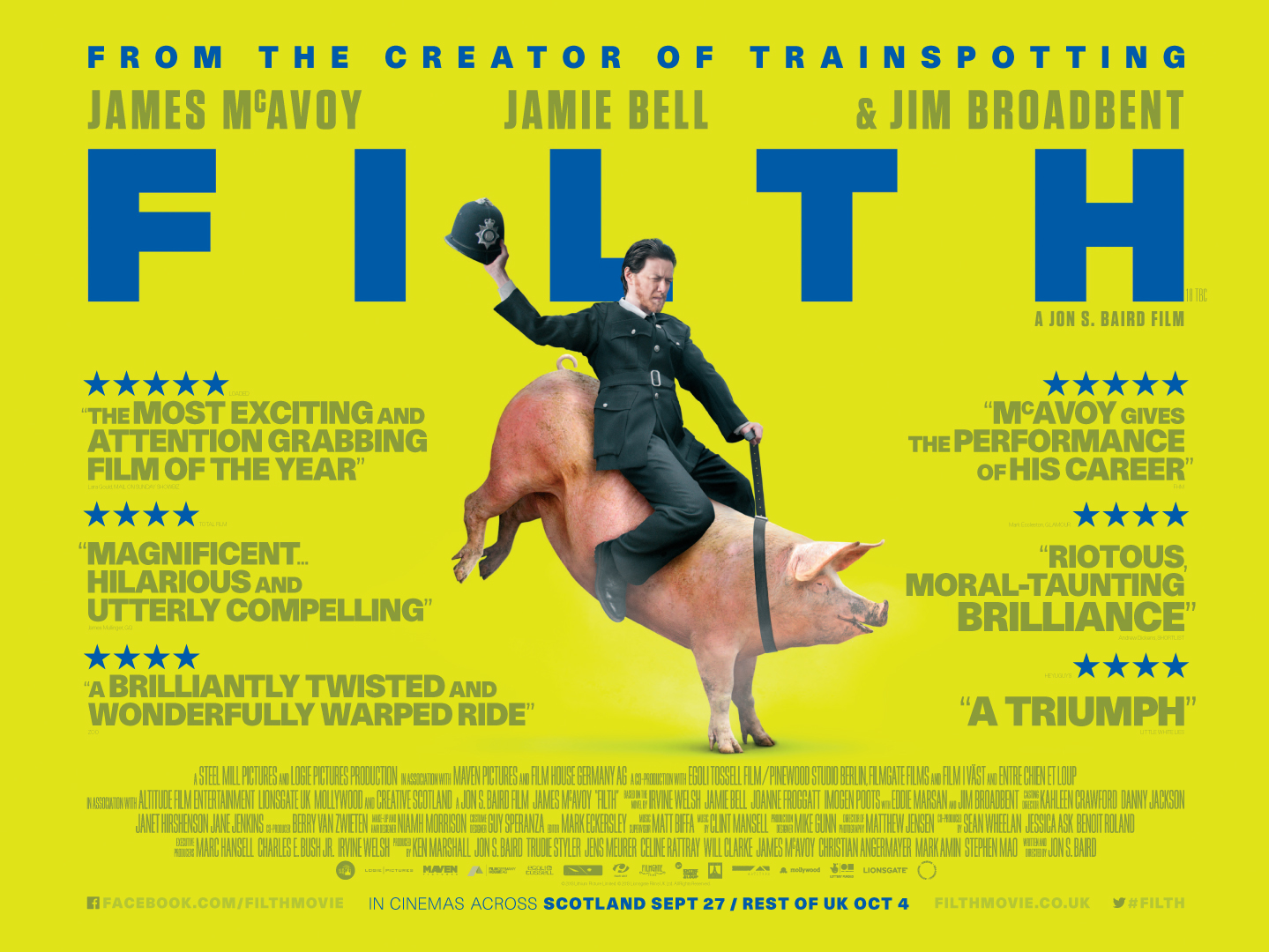
John S. Baid's "Filth" is dirty, wretched and out of control right from the get-go. It initially reminded me a lot of Scorsese's "The Wolf of Wall Street", but as it moved into its second hour, I found myself much more engaged in the story than I ever was during "Wolf", the main reason being that this film actually has a sense of self awareness and some interesting characters. The movie is an adaptation of Irvine Welch's novel of the same name, and it stars James McAvoy in the leading role as a twisted, drunken, vile and corrupt Edinburgh cop by the name of Bruce Robertson, who has made it his personal goal in life to be as big of an ass to everyone around him as humanly possible. 

The darkest comedy of 2013:
This film is dark. Not just traditionally dark à la "Fargo", "In Bruges" or "American Beauty", but dark as in "American Psycho" with a twist of "Se7en" and a smidgen of "No Country For Old Men". In other words, do not go into this film expecting it to be light and entertaining, because even though it truly is funny, it also contains some of the most brooding, depressing and jaw dropping scenes I have seen in quite a while. The film is not gory or frightening in traditional horror movie fashion, but chocking and disturbing in a twisted "Requiem for a Dream"/"Trainspotting" heroin junkie kind of way. And yes, in case of Filth, that actually is a good thing.

Hugely stylised, but not just smoke and mirrors:
The thing that I did not like about The Wolf of Wall Street was the way in which it acted as if it had a lot to say, without actually saying anything worth remembering. Scorsese spent three hours trying to make his audience interested in Leonardo DiCaprio's character and failed miserably, and even though James McAvoy's character has a lot in common with Leo's, Filth is a much richer movie in terms of depth, thematic value and pure entertainment, because of the way in which it acknowledges what kind of genre it fits into, and sticks to those roots throughout the film. Sure, the actual story is barely better than mediocre and does hit a few fairly substantial rough patches, but given its blatantly grotesque and warped nature, the film as a whole does not suffer that much because of it. John S. Baid knew his possibilities and limits when he set out to adapt Irvine Welch's novel, and his efforts payed off in my opinion. 

James McAmazing:
Bruce Robertson is in almost every scene in this film, and James McAvoy does an immaculate job of portraying the character and his filthy lifestyle, delivering what I believe to be the pest performance of his young career. Robertson is a very physical and in-your-face type of person, and McAvoy portrays this aspect of his character in a very controlled and confident but also outrageous and explosive manner, which really emphasized his repulsively vulgar and bipolar personality. There is no denying the fact that Bruce is a filthy and disgusting person with no sense of compassion or empathy whatsoever, but his disturbing behaviour and complete disregard of everything decent and morally acceptable is still very interesting to behold. Thanks to a top notch performance and some truly great writing, the character of Bruce Robertson is the single most positively appalling characters put on screen in 2013, and the fact that DiCaprio got nominated for the Oscar over McAvoy makes me both sad and disappointed. 

The verdict:
Despite its average story and slightly unbelievable premise, John S. Baid's Filth is one of the most original movies I have seen in a long long time, as well as one of the funniest and most chocking movies of 2013. I am currently catching up on as many of the most interesting movies from last year as I can, in order come up with as believable a top 10 list of last year's movies as possible, and I would not be surprised if Filth makes that list. It is a grotesque piece of work that is likely to offend a whole bunch people, but in my opinion, this bombastic nature is the thing that makes the film as engaging and entertaining as it is. Those of you who liked The Wolf of Wall Street should go out and watch Filth right away, because in between those two thematically similar films, I think the latter is the better movie by far. 

Sunday, 26 January 2014

Dallas Buyers Club (2013) - A Movie Review by Andrew Lawrence

Director: Jean-Marc Vallée
Screenwriters: Craig Borten, Melisa Wallack 
Stars: Matthed McConaughey, Jared Leto, Jennifer Garner 
Trailer link
IMDb page

The Matthew McConassance: 
After doing "Ghosts of Girlfriends Past" in 2009, Matthew McConaughey took a break from acting. He had been making romantic comedies almost exclusively up until then, and was suffering from one of the most severe cases of typecasting syndrome in history, playing the typical good looking playboy in every movie he ever appeared in. The native Texan seemed determined to break this curse when he eventually returned to the screen in 2011, and after turning in a string of great performances in alternative low budget films such as Bernie, Killer Joe, Magic Mike and Mud, McConaughey quickly became on of the hottest American actors working today, landing leading roles in 2014's "Interstellar", the upcoming Christopher Nolan film, and one of 2013's leading Oscar contenders, Jean-Marc Vallée's long awaited Dallas Buyers Club. McConaughey seems to be unstoppable at the moment, and if you were to trust most critiques and audiences, his performance in this movie is the best he has ever given. 

A most troublesome decade:
Dallas Buyers Club had a long journey to the silver screen, with actors such as Woody Harrelson, Ryan Gosling and Brad Pitt attached to it, before Matthew McConaughey finally was able to get it off the ground by financing parts of the production himself. The film takes place in 1985, where a homophobic trailer trash-redneck by the name of Ron Woodroof is diagnosed with the HIV virus during the AIDS epidemic of the 1980's. No one knew anything about the virus back in 1985, and when Ron learns that the most effective drugs have not yet been approved for distribution in the US, his personal struggle to survive evolves into a full blown war against the pharmaceutical corporations and the doctors who are prescribing dangerous meds to sick Americans. Not only does Woodroof come up with a clever way of getting the right drugs to the people who desperately need them, but his predicament also serves as a catalyst to a personal transformation that changes his perception of life completely. 

Come aboard the Oscar-wagon!:
Given the humanistic and historical nature of the film, Dallas Buyers Club was destined to get a lot of awards consideration even before it premiered at the Toronto Film Festival in early September. McConaughey and Jared Leto lost a lot of weight in order to portray their AIDS-smitten characters as truthfully as possible, the film makes good use of the classic "bad person turns into a better person though trials and tribulations"-recipe, and it deals with a piece of American history that had a lot of impact on the way things work today. That being said tough, Dallas Buyers Club actually has a lot to offer in terms of storytelling and artistic value, and thanks to some great editing and genuinely engaging performances, it manages to break the common "Oscar bait"-stereotype, and thus becomes more than an excuse for McConaughey and Leto to win some flashy statues. 

The man in the middle:
Anyone who follows the awards race at least somewhat actively, will know that Matthew McConaughey is the current favourite to win this year's Oscar for best performance by an actor in a leading role. I have not seen all of the best movies from 2013 yet, but based on what I saw in Dallas Buyers Club, it would come as a surprise to me if Matt M. does not take home the coveted statue. He is more than just unrecognizable in this movie, and even though I personally am getting a bit tired of his characteristic southern mannerisms, his performance as Ron Woodroof is very impressive, and he manages to make the character both appalling and engaging at the same time. I personally think his performance in Ben Nichols' Mud is slightly better, but him winning the Oscar for Dallas Buyers Club still would not be a bad thing in my opinion. 

A double-edge sword of editing:
One of the things that elevated this film from "good" to "very good" for me, is the way in which some the scenes are edited. Especially the first 45 minutes felt very snappy and engaging in my opinion, because instead of using long expositional chunks of dialogue to propel the story he was trying to tell, the director, who also co-edited the film, chose to use facial expressions and quick cuts in order to explain what happens next. I absolutely love when movies pull this off effectively, and Dallas Buyers Club does it very very well. Jean-Marc Vallée and Martin Pensa did get an Oscar nod for best editing, and had the middle portion of the film not suffered from some tonal inconsistencies and a few fairly repetitive scenes, I think they would have been the front runners in this category. As it is the case with all of the other technical awards however, "Gravity" probably will end up taking it home instead. 

A very solid over all product: 
In my opinion, Dallas Buyers Club is a very good movie with some very good central performances, that could have been even better if its budget had been a little more generous. A significant part of the the middle of the film did feel repetitive and a bit off kilter in my opinion, and I was not surprised to learn that the movie was shot in just 27 days on a budget of 4,5 million dollars, often using hand held cameras and natural lighting. This film is a passion project for the director and most of the main cast; a fact that clearly comes to show in some of its more emotional scenes, and I respect them for creating such a good movie with what little money and time they had on their hands. Dallas Buyers Club is just short of being one of my favourite films of 2013, but it is still one heck of a movie that I would recommend to just about anyone who enjoys good movies and incredible acting.